
Executive Dossiers & Forensic Schematics
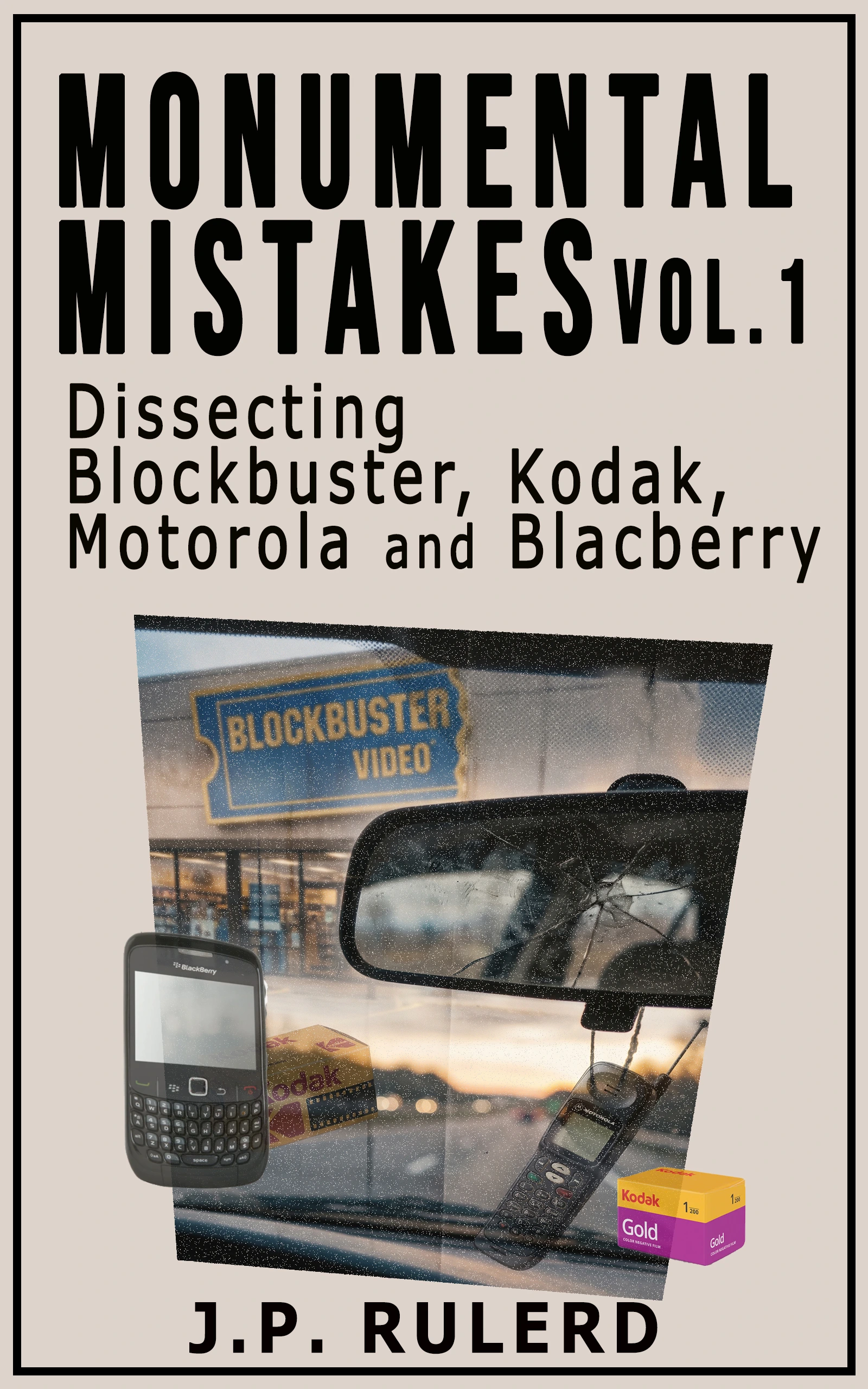
Primary visual artifacts cited throughout the print edition of Monumental Mistakes (Vol. 1). These uncompressed diagrams reconstruct the four accounting traps, orbital link-margin physics, internal patent schematics, and carrier fee routing loops that corporate boards obscured behind quarterly investor decks.
Across four decades of modern corporate history, four industry leaders reached the absolute apex of their markets, only to vanish into federal bankruptcy court or liquidate their core divisions. At its peak in 2000, Blockbuster operated 9,000 retail video stores globally and controlled 43 million customer accounts. In 1976, Eastman Kodak commanded 90 percent of the United States photographic film market and 85 percent of camera sales. By 1998, Motorola had engineered and launched Project Iridium, a $5 billion constellation of 66 low-earth-orbit satellites built to provide the first planetary voice network. In June 2008, Research In Motion achieved an $83 billion market capitalization on the NASDAQ, wiring the global financial and political elite through its encrypted BlackBerry network.
Within a few years of those milestones, all four empires lay in ruins. Between 1999 and 2013, they surrendered an aggregate $120.4 billion in peak equity valuation. None of these four organizations was blindsided by external inventors. They built the future inside their own laboratories first.
Dossier 01 The Four Accounting Traps Matrix
Cross-Corporate DiagnosticHow standard corporate finance metrics actively criminalize strategic innovation:
Kodak charged its digital camera division an internal accounting penalty for every projected roll of 35mm film displaced, artificially turning digital sales into paper net losses.
Blockbuster tied the quarterly bonuses of store employees and regional managers to collecting $800M in 100% gross-margin late fees, creating internal mutiny when Total Access waived them.
Corporate finance committees enforced 25%–40% Internal Rate of Return (IRR) hurdle rates, automatically rejecting low-margin emerging hardware even when market share was hemorrhaging.
Motorola capitalized interest on $750M Chase Manhattan syndicated credit lines into satellite asset values, creating an accounting illusion that shattered when commercial subscriber volume missed targets by 97%.
Dossier 02 The $1.9 Billion Lease Wall vs. Algorithmic Fulfillment (1998–2010)
Capital Structure AsymmetrySeptember 2000 Dallas Meeting: Reed Hastings & Marc Randolph propose $50M sale to John Antioco & Edward Stead.
2004 Viacom Spin-off: Sumner Redstone extracts $905M cash special dividend.
2007 Total Access Surge: Blockbuster reaches 3.6M online subscribers at $2.00 unit envelope loss.
September 2010 SDNY Chapter 11: Blockbuster holds $1.9B in future operating lease commitments.
Dossier 03 US Patent 4,131,919 Schematics (Sasson / Hughes, 1978)
Issued December 26, 1978Steve Sasson (24 years old, supervised by Gareth A. Hughes) assembled the world’s first solid-state digital camera in Rochester under CEO Walter Fallon. The 8.5-pound prototype used a Fairchild CCD sensor, 16 NiCad batteries, and a Philips digital cassette recorder. Tape recording time: 23 seconds.
Dossier 04 Orbital Physics vs. Terrestrial GSM Reality (1998)
15.5 dB Link Margin Failure- • Weight: 454 grams (16 oz / 1.0 lb)
- • Retail Price: $3,000 USD
- • Airtime Rate: $3.00 – $7.00 / minute
- • Link Margin: 15.5 dB (Zero indoor penetration)
- • Form: Swappable cellular cassettes, belt pager
- • Weight: 137 grams (4.8 oz)
- • Retail Price: $200 – $300 USD (Subsidized: $0)
- • Infrastructure: SS7 + SIM roaming across 120 nations
- • Link Margin: 25–30 dB (Deep indoor penetration)
- • Leadership: Nokia CEO Jorma Ollila
Dossier 05 The Waterloo NOC Service Access Fee Loop vs. Flat IP Pipes
Carrier Revenue-Share TrapResearch In Motion routed all global BlackBerry traffic through its proprietary Network Operations Center (NOC) in Waterloo, Ontario. By compressing email payloads down to 2KB packets, RIM saved carrier spectrum and extracted a $3 to $5 monthly consumer fee ($15 for enterprise BES) per subscriber, representing 16% of total revenue.
The Fatal Disruption: Steve Jobs negotiated flat $30/month unlimited data plans with AT&T for the iPhone, treating mobile carriers as commoditized dumb pipes. Concurrently, Microsoft VP Bob Kelly licensed Exchange ActiveSync directly to Apple, breaking the BES firewall via BYOD. Finally, Jan Koum and Brian Acton scaled WhatsApp using universal MSISDN phone numbers instead of 8-character PINs, rendering BlackBerry Messenger (BBM) obsolete.
Corporate Restructuring & Financial Glossary
Audited definitions for featured search queries, financial analysts, and corporate restructuring specialists.
What is Cash-Flow Narcissism?
Cash-Flow Narcissism is an executive and organizational pathology wherein legacy assets with 70% to 100% gross margins actively penalize corporate decision-makers for funding lower-margin emerging realities. It is not an emotional resistance to change, but a rational mathematical consequence of compensation design, corporate finance hurdle rates, and cost accounting practices.
When an enterprise achieves monopoly or duopoly profits in a mature product category, its cost structure, middle-management career trajectories, and executive compensation plans become calibrated around maintaining those exact cash flows. Any new initiative—regardless of how strategically vital to future survival—is measured against the legacy profit engine and crushed via three corporate weapons:
1. Internal Cannibalization Taxes
Corporate finance departments require emerging product divisions to account for lost legacy gross profit. At Eastman Kodak, when digital engineers calculated the unit economics of a digital camera, finance analysts demanded that the digital P&L absorb the gross margin lost from 35mm photographic paper, color developer chemicals, and yellow packaging film. Predictive cannibalization models proved that every digital camera sold into a household erased over $100 in annual recurring film and chemical revenue.
2. EBITDA Bonus Handcuffs
Executive bonuses and field compensation are indexed to short-term EBITDA (Earnings Before Interest, Taxes, Depreciation, and Amortization) covenants. At Blockbuster LLC, late fees generated $800 million annually at virtually 100% gross profit, representing 16% of total revenue. Store managers, district directors, and senior corporate vice presidents had up to 40% of their annual cash compensation pegged to store-level EBITDA targets that could only be met by enforcing punitive late fees on customers who failed to return videotapes within 72 hours. When CEO John Antioco launched Total Access to waive late fees and compete with Netflix, the field organization revolted because their personal bonuses evaporated.
3. Hurdle Rate Vetoes
Corporate capital allocation committees enforce strict Internal Rate of Return (IRR) hurdle rates—frequently requiring 25% to 40% projected annual return on invested capital. Emerging technological platforms typically begin with single-digit gross margins and negative initial cash flows. Under discounted cash flow (DCF) modeling, corporate treasurers systematically veto seed investments in nascent platforms because the spreadsheet demonstrates that investing another $100 million into optimizing legacy factories generates higher risk-adjusted present value.
What is a Section 363 Bankruptcy Sale?
A Section 363 Bankruptcy Sale refers to Section 363 of Title 11 of the United States Bankruptcy Code, which authorizes a debtor-in-possession or trustee to sell corporate assets outside the ordinary course of business “free and clear of any interest in such property of an entity other than the estate.”
In corporate restructuring, a Section 363 sale allows a distressed acquirer to cherry-pick operational assets—such as patent portfolios, satellite constellations, or retail software systems—while legally shedding billions of dollars in senior debt, lease obligations, and operational liabilities.
The $25 Million Iridium Constellation Buyout: On December 12, 2000, U.S. Bankruptcy Judge Robert Farnan in Wilmington, Delaware approved the Section 363 sale of Iridium LLC’s 66-satellite low-Earth orbit constellation to Dan Colussy’s investor group for $25 million in cash. The asset had cost Motorola and syndicated bank lenders over $5 billion to develop and deploy. Colussy acquired the entire global space communications grid for one-half of one cent on the dollar, backed by a $72 million anchor service contract from the U.S. Department of Defense.
Dish Network’s $320 Million Blockbuster Purchase: In April 2011, Dish Network (led by Charlie Ergen and Joe Clayton) utilized Section 363 in the U.S. Bankruptcy Court for the Southern District of New York to acquire Blockbuster’s brand, digital streaming library, and remaining corporate stores for $320 million, leaving behind over $1 billion in legacy bond debt and billions in rejected commercial real estate liabilities.
Eastman Kodak’s $525 Million Patent Consortium Auction: Under SDNY Judge Allan Gropper in December 2012, Kodak sold its cornerstone digital imaging patent portfolio under Section 363 for $525 million to a syndicate backed by Apple, Google, Microsoft, Facebook, and Intellectual Ventures/RPX.
What is a Section 365 Lease Rejection?
Under Section 365 of the U.S. Bankruptcy Code, a Chapter 11 debtor possesses the statutory right to assume or reject unexpired executory contracts and commercial real property leases.
Section 365 of the U.S. Bankruptcy Code empowers a Chapter 11 debtor to legally reject hundreds of underwater commercial lease agreements out of its $1.9 billion minimum operating lease commitment without paying early-termination penalties. Blockbuster LLC relied on Section 365 in its September 23, 2010 Chapter 11 restructuring to unilaterally shed hundreds of unprofitable strip-mall locations.
What is Sell-In vs. Sell-Through Revenue Recognition?
The structural divergence between Sell-In and Sell-Through represents one of the most perilous traps in GAAP revenue recognition for consumer electronics manufacturers:
Sell-In: Revenue recognized by the manufacturer when devices are shipped from the assembly plant or warehouse and accepted by wholesale distributors or wireless carriers (e.g., Verizon, AT&T, Vodafone).
Sell-Through: The metric tracking when that physical hardware is purchased and activated by an end-consumer at a retail store or online checkout.
When an enterprise relies on aggressive sell-in figures to validate quarterly earnings, it creates an inventory mirage. In early 2013, BlackBerry CEO Thorsten Heins announced that the company had shipped 1.0 million BlackBerry Z10 units into carrier distribution channels, beating Wall Street consensus estimates. The stock surged on reported sell-in revenue.
In reality, sell-through was minimal. Handsets sat unsold in carrier warehouses. By September 2013, carriers refused additional shipments, forcing BlackBerry to record a devastating $934 million pre-tax inventory write-down on September 20, 2013.
The Four Corporate Autopsies
Audited balance-sheet breakdowns, courtroom records, and strategic inflection points across Blockbuster, Kodak, Motorola, and BlackBerry.
Blockbuster LLC: The $800 Million Late-Fee Heroin Drip
Blockbuster LLC Forensic Metrics (1997–2010)
Securities and Exchange Commission Form 10-K & SDNY Bankruptcy Filing
| Financial / Operational Metric | Peak Milestone (1997–2004) | Restructuring / Liquidation (2010–2011) |
|---|---|---|
| Peak Annual Revenue | $6,000,000,000 | $1,460,000,000 |
| Global Store Footprint | 9,094 Stores | 3,300 (Rejection) → 0 |
| Annual Late-Fee Revenue | $800,000,000 (16% Rev) | $0 (Eliminated) |
| Late-Fee Gross Margin | 100.0% | N/A |
| Viacom Special Cash Dividend | $905,000,000 Sunk | Funded with $1.45B Debt |
| Enron VOD JV Accounting | $110,000,000 MTM Gain | $0 Cash Realized |
| Total Operating Lease Commitments | $1,900,000,000 | Section 365 Rejection |
| Dish Network Sec. 363 Buyout | $2.63B IPO Valuation (1999) | $320,000,000 Cash |
In 1997, incoming CEO John Antioco executed an operational turnaround. Under the traditional VHS wholesale model, Hollywood studios sold videotapes to video rental shops at $65 to $80 per cassette. Store owners could only afford three or four copies of major titles, leaving suburban customers staring at empty shelves. Antioco called the traditional video store experience “managed dissatisfaction”—customers drove to stores, hoped popular titles were returned, and paid late fees when delayed. Antioco negotiated the Pay-Per-Transaction (PPT) revenue-sharing agreement with the major Hollywood studios: Blockbuster purchased tapes for just $5 to $8 each upfront, remitting roughly 40% of rental revenue back to the studio. Suddenly, Blockbuster could afford to rack dozens of copies of every new release.
Revenue expanded toward $6 billion. But inside that revenue engine sat a lethal accounting trap: $800 million in annual late fees.
Late fees carried zero cost of goods sold. They were 100% pure gross margin. Blockbuster’s operational accounting relied on a strict 3-day rental window; once breached, the computerized POS system automatically compounded $1-per-day penalties (later legally reframed by General Counsel Edward Stead as automatic ‘extended viewing rentals’).
In September 2000, Reed Hastings, Marc Randolph, and CFO Barry McCarthy flew to Dallas to meet with CEO John Antioco and Blockbuster General Counsel Edward Stead, offering to sell Netflix (then tracking toward a $57 million annual loss) for $50 million. Antioco struggled not to laugh, dismissing Netflix as a “very small niche business,” while General Counsel Edward Stead killed the pitch outright, telling Hastings: “The dot-com hysteria is completely overblown. You’re losing money. What do you have that we couldn’t just do ourselves?”
Two months prior, in July 2000, Blockbuster had announced a 20-year exclusive video-on-demand agreement with Kenneth Lay and Ken Rice of Enron Broadband Services. Under mark-to-market accounting, Enron booked a fraudulent $110 million gain on the unproven joint venture. By March 2001, the deal collapsed: U.S. residential broadband penetration was only 3%, Hollywood studios refused to license first-run content (leaving only 130 obscure films available), and fiber bandwidth transmission costs drastically exceeded the $3.99–$4.99 rental price.
When Antioco launched Total Access in late 2006—allowing subscribers to exchange mailed DVDs in physical stores for free instant rentals—Blockbuster added 3.6 million online subscribers, halving Netflix’s churn. But Total Access triggered a bitter civil war with the Blockbuster Independent Franchisee Association (BIFA), led by Alan Payne of Franchise Management Inc. Franchisees, who paid 8%–10% royalty checks, resented that their fees subsidized Blockbuster Online while stores absorbed a $2.00 per-envelope store drop-off cost.
Activist investor Carl Icahn accumulated a 9.6% stake, captured three board seats, stripped Antioco of authority, and retroactively altered 2006 EBITDA performance targets to withhold Antioco’s contractually agreed $7.65 million bonus. Antioco resigned in July 2007 with a $24.7 million contractual severance package. Icahn installed former 7-Eleven CEO Jim Keyes, who dismantled Total Access digital marketing to sell popcorn and electronics in physical retail aisles. Icahn later lost an estimated $180 million before Blockbuster filed for Chapter 11 on September 23, 2010 ($1.02 billion in assets vs. $1.46 billion in debt). In April 2011, Dish Network (led by Charlie Ergen and Joe Clayton) acquired Blockbuster out of Section 363 for $320 million in cash.
The Dallas Boardroom Coup & The $24.7 Million Exit
"When Carl Icahn retroactively altered 2006 EBITDA formulas to withhold John Antioco's $7.65 million incentive bonus, he shattered the leadership of Blockbuster Total Access. Antioco walked away in July 2007 with a contractually mandated $24.7 million severance package, leaving behind a 3.6-million subscriber engine that Jim Keyes promptly dismantled to sell candy and consumer electronics. Read the full boardroom reconstruction in Chapter 1 of Monumental Mistakes (Vol. 1)."
The complete boardroom reconstruction, witness testimony, and audited financial autopsy are fully documented in Monumental Mistakes (Vol. 1).
Order Monumental Mistakes (Vol. 1) →Eastman Kodak: The Razor-and-Blade Chemical Moat
Eastman Kodak Forensic Metrics (1975–2012)
SEC Form 10-K Audited Statements & SDNY Bankruptcy Filing (Judge Allan Gropper)
| Financial / Strategic Metric | Peak Milestone | Bankruptcy Filing (2012) |
|---|---|---|
| Peak Annual Revenue | $20,000,000,000+ | $6,000,000,000 |
| US Photographic Film Market Share | 90.0% Dominance | <5.0% Residual |
| Silver-Halide Chemical Gross Margin | 75.0% – 80.0% | Negative (Plant Shutdown) |
| First Digital Camera Resolution | 0.01 Megapixel (1975) | 14+ MP Commodity |
| Sterling Drug Acquisition Debt | $5,100,000,000 Sunk | Sold at Loss |
| Advantix APS R&D Investment | $1,000,000,000 Sunk | Obsolete on Arrival |
| Ofoto Acquisition / Purchase Price | Over $50,000,000 (2001) | Forced $0.49 Paper Prints |
| Sec. 363 Patent Auction Proceed | $2,600,000,000 Claimed | $525,000,000 Realized |
For over a century, the Eastman Kodak Company did not sell photography. It operated a currency printing press disguised as a chemical manufacturing facility across the 1,300-acre Kodak Park in Rochester, New York. George Eastman’s genius was the razor-and-blade business model: sell consumer cameras at razor-thin margins or cost, and extract a lifetime stream of 70% to 80% gross-margin profits from yellow boxes of film, photographic paper, and processing chemistry.
In December 1975, a 24-year-old Kodak electrical engineer named Steve Sasson, working under supervisor Gareth A. Hughes and CEO Walter Fallon, constructed the world’s first solid-state digital camera. His 8.5-pound prototype used a Fairchild CCD sensor, 16 NiCad batteries, and a Philips digital cassette recorder, recording a 100x100 pixel (0.01 megapixel) image onto tape in 23 seconds and displaying it on a laboratory television screen. When demonstrated to management, the executive reaction was immediate: “That’s cute, Steve—just don’t tell anyone about it.”
In 1980, the Hunt brothers’ attempt to corner the global silver market caused silver prices to surge from $6 to nearly $50 per ounce, adding $500 million in raw material costs to Kodak’s cost of goods sold. In 1986, Head of Market Intelligence Vince Barabba handed CEO Colby Chandler and the board a mathematical ten-year forecast showing that digital imaging would reach parity with chemical film between 1996 and 1998. Barabba presented a clear timeline to transition.
Instead, Kodak suffered catastrophic strategic detours:
The $5.1 Billion Sterling Drug Diversion (1988): Under CEO Colby Chandler, Kodak acquired pharmaceutical company Sterling Drug for $5.1 billion, rationalizing that pharmaceutical chemicals aligned with its manufacturing capabilities. The debt hobbled balance-sheet flexibility for a decade.
The 1990 Windows Pitch: CEO Kay Whitmore launched the hybrid Photo CD, but famously fell asleep in his armchair during Bill Gates’s 1990 presentation on integrating digital imaging into Windows.
The Apple QuickTake 100 Surrender (1994): Incoming CEO George Fisher surrendered the 1994 Apple QuickTake 100 ($749, 0.3MP) as an OEM white-label deal to Apple CEO Michael Spindler, declining to put the Kodak brand on the consumer digital revolution.
The $1 Billion Advantix (APS) Cartridge Detour (1996): Kodak sank over $1 billion developing Advantix, an Advanced Photo System hybrid cartridge that recorded magnetic metadata alongside film, while digital division chief Willy Shih was starved of development resources.
The Ofoto $0.49 Print Sabotage (2001): In June 2001, CEO Dan Carp acquired Ofoto (founded by Lisa Gansky) for over $50 million. Instead of building Ofoto’s 1-million user base into an online photo-sharing network, management redesigned the service to coerce users into ordering $0.49 physical paper prints.
The Flextronics Outsourcing & Inkjet Gamble: Under Antonio Perez, Kodak outsourced digital camera manufacturing to Flextronics and burned $1 billion attempting to compete against HP in consumer microfluidic desktop inkjet printers.
On January 19, 2012, Eastman Kodak filed for Chapter 11 bankruptcy protection in the Southern District of New York before Judge Allan Gropper, disclosing $5.1 billion in assets against $6.8 billion in liabilities, ultimately auctioning its foundational digital patent portfolio for $525 million.
The Photo CD Compromise & The 1990 Windows Pitch
"In October 1990, Microsoft Chairman Bill Gates pitched Kodak CEO Kay Whitmore on embedding Kodak color science directly into the Windows operating system. As Gates outlined the personal computer imaging revolution, Whitmore fell asleep in his executive armchair, while Rochester chemical lifers funneled over $1 billion into Advantix hybrid film. Read the complete corporate autopsy in Chapter 2 of Monumental Mistakes (Vol. 1)."
The complete boardroom reconstruction, witness testimony, and audited financial autopsy are fully documented in Monumental Mistakes (Vol. 1).
Order Monumental Mistakes (Vol. 1) →Motorola Iridium: The $5 Billion Orbital Echo Chamber
Motorola Iridium Forensic Metrics (1987–2000)
Securities and Exchange Commission Filings & District of Delaware Bankruptcy Filing (Judge Robert Farnan)
| Aerospace / Financial Metric | Original Business Plan (1996) | Bankruptcy Reality (1999–2000) |
|---|---|---|
| Total Sunk Capital Expenditure | $2,500,000,000 | $5,000,000,000+ |
| Active LEO Constellation Nodes | 77 Satellites (Iridium) | 66 Satellites (Dysprosium) |
| Orbital Altitude & Velocity | 483 Miles / 17,000 mph | 483 Miles / 17,000 mph |
| Syndicated Bank Debt (Chase) | $750,000,000 | $1,400,000,000 (Defaulted) |
| Commercial Active Subscribers | 500,000 Active Users | ~20,000 Users (96% Miss) |
| Handset Weight & Pricing | Pocket Sized / $1,000 | 454g (16 oz) / $3,000 |
| Launch Ad Campaign Spend | $50,000,000 Target | $140,000,000 (No Handsets) |
| Sec. 363 Liquidation Price | $5,000,000,000 Value | $25,000,000 (Colussy Buyout) |
In 1987, Motorola engineer Bary Bertiger vacationed on a Caribbean beach with his wife, who lamented that she could not make a phone call to real estate clients. Conceived alongside Ray Leopold and Ken Peterson, Project Iridium was envisioned as an orbital mesh of 77 satellites (named after Iridium’s atomic number 77, later re-architected to 66 satellites, corresponding to Dysprosium). Orbiting at 483 miles altitude at 17,000 miles per hour with 10–40ms latency and Ka-band cross-links, it represented a monumental engineering triumph.
Championed by Bob Galvin and his son Chris Galvin, Motorola cellular head Ed “Fast Eddie” Staiano took command of Iridium LLC. In Chandler, Arizona, Motorola built a 21-day robotic satellite assembly line that produced orbiters at $40 million per node.
In 1996, Motorola syndicated a $750 million credit facility with Chase Manhattan Bank, capitalizing interest payments into satellite assets under GAAP. The bank covenants mandated commercial activation on November 1, 1998, with strict targets of 27,000 active subscribers by May 1999.
To satisfy bank covenants, Iridium was activated on November 1, 1998, with a ceremonial call placed by Vice President Al Gore from the White House Rose Garden to National Geographic Society chairman Gilbert Grosvenor. Simultaneously, ad agency Ammirati Puris Lintas launched the $140 million “Calling Planet Earth” global ad campaign, generating 1.5 million inbound leads.
Yet, the system suffered from fundamental engineering and commercial flaws:
The 15.5 dB Signal Barrier: Handset signals required direct line-of-sight to orbiting spacecraft. Operating with a 15.5 dB link margin, calls failed behind trees, inside cars, or through building glass. Terrestrial cellular systems like GSM operated with a 25–30 dB margin, penetrating deep indoors.
The Form Factor Deficit: The Motorola 9500 handset weighed 454 grams (16 oz / 1.0 lb) and retailed for $3,000 with calls costing $3 to $7 per minute, requiring swappable cellular cassettes and a belt pager. Concurrently, Nokia CEO Jorma Ollila rolled out the Nokia 6110 GSM phone—weighing just 137 grams (4.8 oz) and retailing for $200–$300, supported by SS7 and SIM card roaming across 120 nations.
The Production Failure: When 1.5 million leads responded to the ad blitz, Motorola’s plants had manufactured only a few hundred operational handsets.
By May 1999, Iridium had achieved only ~20,000 active subscribers (most on promotional trials), breaching its Chase Manhattan covenant. A missed $90 million interest payment triggered cross-default provisions on $4.4 billion in debt, forcing Iridium into Chapter 11 on August 13, 1999, before Judge Robert Farnan in the District of Delaware.
Motorola prepared to fire satellite thrusters and de-orbit all 66 spacecraft into the South Pacific spacecraft cemetery at Point Nemo. Former Pan American World Airways president Dan Colussy intervened, executing a $25 million Section 363 acquisition on December 12, 2000. Supported by a $72 million anchor contract from the U.S. Department of Defense ($3 million monthly revenue matching $3 million operating costs, routed through gateways in Hawaii and Tempe), Colussy operated the constellation profitably for decades.
The Point Nemo De-Orbit Ultimatum & The $25 Million Rescue
"Facing a strict deadline from Judge Robert Farnan to incinerate 66 satellites over Point Nemo in the South Pacific, Motorola prepared to spend $40 million on hydrazine burns. Former Pan Am executive Dan Colussy intervened with a $25 million Section 363 buyout, backed by a $72 million Department of Defense anchor contract. Read the full courtroom drama in Chapter 3 of Monumental Mistakes (Vol. 1)."
The complete boardroom reconstruction, witness testimony, and audited financial autopsy are fully documented in Monumental Mistakes (Vol. 1).
Order Monumental Mistakes (Vol. 1) →BlackBerry / RIM: The Waterloo NOC Tollbooth Fortress
Research In Motion (BlackBerry) Forensic Metrics (2007–2016)
TSX / NASDAQ 10-K Filings & Restructuring Disclosures
| Enterprise / Market Metric | Peak Milestone (2007–2008) | Hardware Shutdown (2013–2016) |
|---|---|---|
| Peak Market Capitalization | $83,000,000,000 USD | $3,200,000,000 USD |
| Global Active Subscriber Base | 50,000,000+ Enterprise | Hardware Deprecated |
| Carrier Service Access Fee (SAF) | $3–$5 / sub (16% Rev) | Eliminated by Carriers |
| Global Smartphone OS Market Share | 20.1% Global / 50% US | 0.0% (Gartner, 2016) |
| BlackBerry Storm Return Rate | Near 100% Replacement | Near 100% replacement of 1M units shipped |
| PlayBook Tablet Inventory Write-down | $485,000,000 Charge | No Native Email Client |
| BlackBerry Z10 Inventory Write-down | $934,000,000 Charge | Wholesale Sell-In Mirage |
| Fairfax Financial Debenture Rescue | $4,700,000,000 Bid | $1B Debenture Bailout |
At its apex in June 2008, Research In Motion (RIM), led by co-CEOs Mike Lazaridis and Jim Balsillie, commanded an $83 billion market capitalization. Half of all smartphones sold in the United States carried the BlackBerry logo. The foundation of RIM’s competitive moat was the Waterloo Network Operations Center (NOC). While standard cellular devices consumed megabytes of raw data, RIM’s server infrastructure compressed emails down to 2-kilobyte packets before transmitting them over carrier spectrum. Wireless carriers subsidized handsets and paid RIM a monthly Service Access Fee (SAF) of $3 to $5 per consumer and $15 per corporate user, generating 16% of total revenue.
Following the iPhone’s introduction in 2007, RIM suffered a cascade of strategic and engineering missteps:
The 2008 BlackBerry Storm Disaster: Pressured by Verizon CEO Ivan Seidenberg to deliver an “iPhone killer,” RIM rushed the BlackBerry Storm into production in November 2008. The device incorporated a “SurePress” piezoelectric clickable screen mechanism. The device lagged, registered phantom clicks, and suffered near 100% replacement across 1 million units shipped to carrier stores.
The ActiveSync Breach & App Store Deficit: Microsoft VP Bob Kelly licensed Exchange ActiveSync directly to Apple, breaking the BES firewall barrier via corporate Bring Your Own Device (BYOD) policies managed by MobileIron and AirWatch. RIM’s fragmented Java (J2ME) SDK failed to attract developers compared to Apple’s App Store.
The PlayBook Tablet Blunder: In April 2011, RIM launched the PlayBook tablet. Paralyzed by security orthodoxy and carrier SAF fee protection, RIM shipped the tablet without native email, calendar, or contact apps, requiring users to tether to a BlackBerry phone over Bluetooth via “BlackBerry Bridge.” The failure forced a $485 million pre-tax inventory write-down in late 2011. RIM acquired QNX Software Systems (founded by Dan Dodge) for $200 million to build its next-generation OS.
The Balsillie SMS 2.0 Veto (March 2012): On January 22, 2012, Lazaridis and Balsillie resigned as co-CEOs. Balsillie continued as a director, pitching “SMS 2.0” to license BlackBerry Messenger (BBM) to carriers like AT&T and Vodafone as a universal cross-platform messaging layer across iOS and Android. In March 2012, incoming CEO Thorsten Heins and Chair Barbara Stymiest vetoed the plan to protect proprietary hardware sales. Balsillie resigned from the board in protest. In that vacuum, Jan Koum and Brian Acton scaled WhatsApp (using standard MSISDN phone numbers rather than 8-character PINs) into a global communications platform, leading to its $19 billion acquisition by Facebook.
The $934 Million Z10 Write-Down: On September 20, 2013, after shipping 1.0 million Z10 touchscreen units into carrier channels that consumers refused to buy, BlackBerry recorded a $934 million inventory write-down.
A proposed $4.7 billion buyout by Prem Watsa’s Fairfax Financial was restructured on November 4, 2013, into a $1 billion convertible debenture investment. Turnaround specialist John Chen took leadership, licensed hardware branding to Foxconn and TCL, acquired enterprise security competitor Good Technology for $425 million, and transitioned BlackBerry into an enterprise cybersecurity and embedded automotive software provider (QNX installed in over 60 million vehicles).
The SMS 2.0 Veto & The $19 Billion WhatsApp Vacuum
"In March 2012, incoming CEO Thorsten Heins and Chair Barbara Stymiest killed Jim Balsillie's SMS 2.0 blueprint to license BlackBerry Messenger to major wireless carriers across iOS and Android. Balsillie resigned from the board in protest, creating the exact market vacuum that Jan Koum and Brian Acton seized to scale WhatsApp to a $19 billion Facebook acquisition. Read the full investigation in Chapter 4 of Monumental Mistakes (Vol. 1)."
The complete boardroom reconstruction, witness testimony, and audited financial autopsy are fully documented in Monumental Mistakes (Vol. 1).
Order Monumental Mistakes (Vol. 1) →Protagonist Executive Profiles
Targeted profiles of the key decision-makers, boardroom combatants, and inventors whose strategic assumptions shaped these corporate bankruptcies.
John Antioco vs. Carl Icahn & Jim Keyes
John Antioco (CEO, 1997–2007) & Edward Stead (General Counsel): Antioco spearheaded Blockbuster’s original revenue-share model with Hollywood studios. While General Counsel Edward Stead dismissed Reed Hastings’s $50 million buyout pitch in September 2000, Antioco subsequently recognized the online subscription threat. Antioco launched Total Access, reaching 3.6 million subscribers and halting Netflix’s customer growth.
Carl Icahn & Jim Keyes: Icahn acquired a 9.6% stake, aligned with disgruntled franchisees, stripped Antioco of authority, and altered EBITDA targets to withhold his $7.65 million bonus. Antioco departed in July 2007 with a contractually mandated $24.7 million severance package. Successor Jim Keyes dismantled Total Access marketing, focusing on in-store retail merchandising. Icahn later liquidated his stake at an estimated $180 million loss before Blockbuster’s 2010 Chapter 11 filing.
Steve Sasson, Vince Barabba, Kay Whitmore & George Fisher
Steve Sasson & Vince Barabba: Sasson invented the 0.01MP solid-state digital camera in 1975 under Walter Fallon. In 1986, Head of Market Intelligence Vince Barabba presented a detailed ten-year mathematical forecast showing that digital imaging would match chemical film by the late 1990s, giving Kodak a clear window to transition its business model.
Kay Whitmore, George Fisher & Willy Shih: Whitmore (CEO, 1990–1993) prioritized chemical investments and fell asleep during Bill Gates’s 1990 Windows presentation. George Fisher (CEO, 1993–1999) licensed the 1994 QuickTake 100 to Apple as an OEM product and sank $1 billion into Advantix hybrid film. Digital division chief Willy Shih was starved of capital as yellow-box lifers protected silver-halide gross margins.
Bary Bertiger, Ed “Fast Eddie” Staiano & John Richardson
Bary Bertiger & Ed Staiano: Bertiger conceived the satellite constellation in 1987 alongside Ray Leopold and Ken Peterson. Staiano drove Iridium through engineering willpower, constructing a 21-day robotic manufacturing line for 66 satellites.
John Richardson & Dan Colussy: Richardson took interim command as subscriber numbers stalled at ~20,000, confronting the 15.5 dB indoor link failure and $3,000 handset cost against Nokia’s 137g GSM phones. After Iridium’s $4.4 billion default and Judge Farnan’s Point Nemo de-orbit ultimatum, former Pan Am president Dan Colussy rescued the asset in a $25 million Section 363 transaction, sustained by a $72 million Department of Defense contract.
Mike Lazaridis, Jim Balsillie, Thorsten Heins & John Chen
Mike Lazaridis & Jim Balsillie: Co-CEOs who built RIM into an $83 billion market leader on the strength of the Waterloo NOC 2KB compression engine and carrier Service Access Fees. Their alignment collapsed over touchscreen consumer dynamics and cross-platform messaging strategy.
Thorsten Heins & John Chen: In March 2012, incoming CEO Thorsten Heins and Chair Barbara Stymiest vetoed Balsillie’s SMS 2.0 cross-platform BBM initiative. The resulting $934 million Z10 inventory write-down in September 2013 triggered a $1 billion debenture rescue by Prem Watsa’s Fairfax Financial. CEO John Chen restructured the enterprise, licensing phone manufacturing to TCL and Foxconn, acquiring Good Technology for $425 million, and positioning QNX automotive software into tens of millions of vehicles.
Primary Source & Court Docket Repository
In accordance with Google Search Quality Guidelines, all corporate autopsies in Monumental Mistakes (Vol. 1) are cross-referenced against unsealed federal bankruptcy court records, Securities and Exchange Commission 10-K filings, and patent registrations.
- U.S. Bankruptcy Court for the Southern District of New York (SDNY)
• Blockbuster Inc. Chapter 11 Proceeding: Filed September 23, 2010. Disclosed $1.02 billion in total assets against $1.46 billion in funded debt obligations and $1.9 billion in minimum operating lease liabilities. Orders authorizing Section 365 lease rejections and Section 363 sale to Dish Network Corporation ($320 million, April 2011).
• Eastman Kodak Company Chapter 11 Proceeding: Judge Allan L. Gropper presiding. Filed January 19, 2012. Disclosed $5.1 billion in assets against $6.8 billion in total liabilities. Order authorizing Section 363 digital imaging patent consortium sale ($525 million, December 2012).
- U.S. Bankruptcy Court for the District of Delaware
• Iridium LLC Chapter 11 Proceeding: Judge Robert J. Farnan presiding. Filed August 13, 1999. Disclosed $3.4 billion in assets against $4.4 billion in total liabilities. Order authorizing the Section 363 asset purchase agreement to Iridium Satellite LLC (Dan Colussy / Pentagon syndicate) for $25 million cash consideration, entered December 12, 2000.
- Jefferson County District Court, Beaumont, Texas
• Scott v. Blockbuster Inc.: Class-action litigation challenging late-fee penalty structures under consumer protection statutes. Final approval order entered April 2001 approving $450 million in coupon remedies.
- United States Patent and Trademark Office (USPTO)
• US Patent 4,131,919: “Electronic Still Camera.” Issued December 26, 1978. Inventors: Steven J. Sasson, Gareth A. Hughes. Assignee: Eastman Kodak Company (Rochester, NY). Landmark patent documenting the 100x100 pixel charge-coupled device (CCD) and magnetic tape recording apparatus.
Forthcoming Monograph
Monumental Mistakes: Volume 2
The Series Waitlist & Pre-Launch Previews
J.P. Rulerd returns with the next volume of corporate governance and restructuring investigations. Readers on the series waitlist receive early chapter drafts, unsealed court docket summaries, and direct publisher pre-order notifications.
Rulerd Press • Forthcoming